Wednesday, August 12, 2009

What Does HR 3200 Actually Say?

If you don't want to read the entire 1016 pages of House Resolution 3200 - the "America's Affordable Health Choices Act of 2009" - then you might consider a summary by someone who has done the homework that we each should have already done.
 
http://www.classicalideals.com/HR3200.htm was put together by Dr. John David Lewis, professor of Classical History and Political Economics at Duke University.  He provides questions, the applicable sections from HR 3200, and his evaluation of the proposed law.
 

Saturday, August 8, 2009

Support for Health Care Reform

So what level of support is there for a major change in Health Care in this country? An article by Scott Rasmussen in the Wall Street Journal reports some interesting statistics from recent polls, just a day after the current resident of the Oval Office said that those who oppose the idea should keep their mouths shut.
 
So what do the people think?
- Obama says the plan he's selling will reduce costs, but 53% of the people believe it will have the opposite effect.
- 74% rate the quality of care they currently receive as good or excellent.
- 50% of people fear that if this plan is passed, it will result in a decline in quality of care.
- By a factor of two to one, people think that no matter how bad things might be, congressional action will only make them worse.
- 78% of folks agree that passage of the current congressional plan is likely to mean higher taxes for the middle class
- Although 63% of voters agree that all Americans should have "quality, affordable health care," only 28% are willing to pay higher taxes to achieve that goal.
- Although 25% of voters strongly support the reform effort, 41% strongly oppose it.
- 48% of voters now rate the U.S. health-care system as good or excellent. This is up from 29% a year ago.
- 19% of voters now rate the U.S. health-care system as poor. This is down from 37% a year ago.
- Currently, 76% of Democrat voters favor the reform plan being touted by Obama and the congressional Democrats.
- Currently, 35% of unaffiliated voters favor the plan, versus 60% who are opposed.
- Of these unaffiliated voters, only 16% strongly favor the plan, while 47% strongly oppose it.
 
The House Resolution, euphemistically called "America's Affordable Health Choices Act of 2009," can be found here. Please read it.
Mr Rasumssen's data can be found here.
Rasmussen's Op Ed piece can be found here.
 

Thursday, July 30, 2009

Disaster in the Making

Dr. Thomas Sowell is not only a prescient reader of our postmodern society, he is a student of economics who recognizes the precarious financial condition we find our country in today. This is his column from July 29, as published on Townhall.com. If you would like to read some of his previous columns, you can find them at Jewish World Review. But the economy is only one, and perhaps not the least, of the problems being created by this misguided administration...
After many a disappointment with someone, and especially after a disaster, we may be able to look back at numerous clues that should have warned us that the person we trusted did not deserve our trust.
When that person is the President of the United States, the potential for disaster is virtually unlimited.
Many people are rightly worried about what this administration's reckless spending will do to the economy in our time and to our children and grandchildren, to whom a staggering national debt will be passed on. But if the worst that Barack Obama does is ruin the economy, I will breathe a sigh of relief.
He is heading this country toward disaster on many fronts, including a nuclear Iran, which has every prospect of being an irretrievable disaster of almost unimaginable magnitude. We cannot put that genie back in the bottle-- and neither can generations yet unborn. They may yet curse us all for leaving them hostages to nuclear terror.
Conceivably, Israel can spare us that fate by taking out the Iranian nuclear facilities, instead of relying on Obama's ability to talk the Iranians out of going nuclear.
What the Israelis cannot spare us, however, are our own internal problems, of which the current flap over President Obama's injecting himself into a local police issue is just a small sign of a very big danger.
Nothing has torn more countries apart from inside like racial and ethnic polarization. Just this year, a decades-long civil war, filled with unspeakable atrocities, has finally ended in Sri Lanka. The painful irony is that, when the British colony of Ceylon became the independent nation of Sri Lanka in 1948, its people were considered to be a shining example for the world of good relations between a majority (the Sinhalese) and a minority (the Tamils). That all changed when politicians decided to "solve" the "problem" that the Tamil minority was much more economically successful than the Sinhalese majority. Group identity politics led to group preferences and quotas that escalated into polarization, mob violence and ultimately civil war.
Group identity politics has poisoned many other countries, including at various times Kenya, Czechoslovakia, Fiji, Guyana, Canada, Nigeria, India, and Rwanda. In some countries the polarization has gone as far as mass expulsions or civil war.
The desire of many Americans for a "post-racial" society is well-founded, though the belief that Barack Obama would move in that direction was extremely ill-advised, given the history of his actions and associations.
This is a president on a mission to remake American society in every aspect, by whatever means are necessary and available. That requires taking all kinds of decisions out of the hands of ordinary Americans and transferring them to Washington elites-- and ultimately the number one elite, Barack Obama himself.
Like so many before him who have ruined countries around the world, Obama has a greatly inflated idea of his own capabilities and the prospects of what can be accomplished by rhetoric or even by political power. Often this has been accompanied by an ignorance of history, including the history of how many people before him have tried similar things with disastrous results.
During a recent TV interview, when President Obama was asked about the prospects of victory in Afghanistan, he replied that it would not be victory like in World War II, with "Hirohito coming down and signing a surrender to MacArthur." In reality, it was more than a year after Japanese officials surrendered on the battleship Missouri before Hirohito met General Douglas MacArthur for the first time.
This is not the first betrayal of his ignorance by Obama, nor the first overlooked by the media. Moreover, ignorance by itself is not nearly as bad as charging full steam ahead, pretending to know. Barack Obama is doing that on a lot of issues, not just history or a local police incident in Massachusetts.
While the mainstream media in America will never call him on this, these repeated demonstrations of his amateurism and immaturity will not go unnoticed by this country's enemies around the world. And it is the American people who will pay the price.

Friday, July 24, 2009

Peggy Noonan on Common Sense

If you take the Wall Street Journal, you've probably already read Ms. Noonan's very cogent op-ed piece today. If not, you can find it on-line here. Here's a short clip, the "Common Sense" part:
I think the plan is being slowed and may well be stopped not by ideology, or even by philosophy in a strict sense, but by simple American common sense. I suspect voters, the past few weeks, have been giving themselves an internal Q-and-A that goes something like this:
Will whatever health care bill is produced by Congress increase the deficit? "Of course." Will it mean tax increases? "Of course." Will it mean new fees or fines? "Probably." Can I afford it right now? "No, I’m already getting clobbered." Will it make the marketplace freer and better? "Probably not." Is our health care system in crisis? "Yeah, it has been for years." Is it the most pressing crisis right now? "No, the economy is." Will a health-care bill improve the economy? "I doubt it."

Thursday, July 23, 2009

Obama's Empty MedPac Promise

From the Heritage Foundation this morning:
 
     Americans may distrust economists, and most of them would have a rough time with an Econ 101 final exam if they had to take it today, but through everyday experience Americans also have internalized one of the most fundamental concepts of economics: there is no such thing as a free lunch. And it is because Americans instinctively believe in this fundamentally conservative concept that poll after poll shows Americans no longer trust President Barack Obama on health care. Americans know Obama is not telling the truth and that fact was crystallized in this exchange from last night's press conference:
 
JAKE TAPPER ABC NEWS: You said earlier that you wanted to tell the American people what's in it for them, how will their family benefit from health-care reform. But experts say that in addition to the benefits that you're pushing, there is going to have to be some sacrifice in order for there to be true cost-cutting measures, such as Americans giving up tests, referrals, choice, end-of-life care.
     When you describe health-care reform, you don't - understandably, you don't talk about the sacrifices that Americans might have to make. Do you think - do you accept the premise that other than some tax increases, on the wealthiest Americans, the American people are going to have to give anything up in order for this to happen?
PRESIDENT OBAMA: They're going to have to give up paying for things that don't make them healthier. And I - speaking as an American, I think that's the kind of change you want.
 
     In other words, Obama wants Americans to believe that his health plan covers the uninsured, improves patient care, puts "more money in people's pockets," all while adding nothing to the deficit. Obama is trying to convince Americans to disregard every ounce of common sense that they have and believe he is selling them an actual free lunch. Americans have every right to be skeptical. Take Obama's claims that he can control health care costs by giving more power to a group of experts known as MedPac (Medicare Payment Advisory Commission).
     Congress already has a long track record of putting into place seemingly automatic spending reductions in health, only to block them later. For instance, Congress routinely rolls back the "sustainable growth rate" trimming of Medicare physician payments that were supposed to keep down Medicare costs. Congress similarly decided to ignore the requirement in the 2003 prescription drug legislation that it automatically consider White House proposals to limit taxpayer subsidies for Medicare. Americans have every right to be skeptical about this latest gimmick's capacity for actually bringing down costs. If our health care spending crisis is a long-term one, like Obama says, then Americans should demand that Obama prove he can contain costs in Medicare first before creating a new trillion dollar budget busting entitlement.
     But what if Obama's MedPac idea did work? That might even be a bigger threat to American's health care. It would be the equivalent of a federal health board determining how health care was rationed for all seniors. Combined with the public plan proposal, that would be another huge lurch towards taking the control of health care out of the hands of patients and their doctors.
     Despite Obama's constant insistence otherwise, conservatives do have an alternative vision for health care reform and do not favor the "status quo." For example, Obama wants one single committee of "experts" in Washington to make all medical decisions for everyone in the country. Conservatives take a polar opposite approach. We want to rebuild the health care system from the ground up, not the top down. We want millions of Americans sitting down with their doctors and making millions of decisions every day about what procedures and treatments are best for them. The media is right to be calling out the President for delivering false rhetoric on health care. He's asking us to trust him on a trillion dollar plan he has not read, and to dismiss what all Americans inherently know: Everything has a price.

Wednesday, July 22, 2009

Time to Quit Digging


That should be intuitively obvious, wouldn't you think?

Does Ted Kennedy deserve his extended cancer care?

James Lewis has an article today in The American Thinker, that should spur questions about Obama's socialized health care.
 
     Senator Ted Kennedy, who is now 76 years old and was diagnosed with brain cancer in May of last year, is telling the world that nationalized medical care is "the cause of his life." He wants to see it pass as soon as possible, before he departs this vale of tears.
     The prospect of Kennedy's passing is viewed by the liberal press with anticipatory tears and mourning.  But they are not asking the proper question by their own lights: That question -- which will be asked for you and me when we reach his age and state in life --- is this:
     Is Senator Kennedy's life valuable enough to dedicate millions of dollars to extending it another month, another day, another year?
     Because Barack Obama and Ted Kennedy agree with each other that they of all people are entitled to make that decision. Your decision to live or die will now be in their hands.
     Ted Kennedy is now 76. Average life expectancy in the United States is 78.06. For a man who has already reached 76, life expectancy is somewhat longer than average (since people who die younger lower the national average); for a wealthy white man it may be somewhat longer statistically; but for a man with diagnosed brain cancer it is correspondingly less. As far as the actuarial tables of the Nanny State are concerned, Kennedy is due to leave this life some time soon. The socialist State is not sentimental, at least when it comes to the lives of ordinary people like you and me.
     The socialist question -- and yes, it is being asked very openly in socialist countries all around the world, like Britain and Sweden -- must be whether extending Senator Kennedy's life by another day, another month or year is socially valuable enough to pay for what is no doubt a gigantic and growing medical bill. Kennedy is a US Senator, and all that money has been coughed up without complaint by the US taxpayer. Kennedy is already entitled to Federal health care, and it is no doubt the best available to anyone in the world.
     Before he dies, Senator Kennedy wants to feel sure that you and I and our loved ones can put that personal decision about life or death safely in the hands of a Federal bureaucrat. It is "the cause of his life," we are told.
     Now there are many people in this country who believe that Ted Kennedy has not spent his life very constructively. Mary Jo Kopechne's family might still want to trade his life for hers, if she could be brought back. Senator Kennedy has exercised more power over our immigration chaos than any other person in the last half century. 9/11 was committed by illegal entrants who slipped through our deliberately full-of-holes borders, using all manner of Kennedy-authored loopholes and enforcement gaps.
     Others might point to the socialist habit of importing vast numbers of voters from Pakistan and Somalia into Western Europe, to make for cheap socialist votes in order to defeat and scapegoat native Europeans. Socialism by immigrant vote buying is happening in every single socialist country in Europe. It is what keeps socialist parties there in power. Kennedy has opened our borders for precisely that kind of takeover by masses of illegal immigrants.
     So there might be a rational debate over the social utility of Senator Kennedy's life. We could all have a great national debate about it. Maybe we should do exactly that, to face the consequences of what the Left sees as so humane, so obviously benevolent, and so enlightened.
     Consider what happens in the Netherlands to elderly people. The Netherlands legalized "assisted suicide" in 2002, no doubt in part for compassionate reasons. But also to save money. There is only one money kitty for medical care in the socialist Netherlands. When you get old, the question is asked, either explicitly or by implication:
     Do you deserve to live another year compared to young refugees from Somalia, who can use the same euros to have many years of life?
     There's only so much money available. The Netherlands radio service had a quiz show at one time, designed to "raise public awareness" about precisely that question. Who deserves to live, and who to die?
     But nobody debates any more about who has the power to make that decision. In socialist Europe the State does. It's a done deal.
     The Netherlands legally recognizes four categories of euthanasia.  One of them is:
Passive euthanasia: A physician may choose not to treat an recurrent disease or event in a patient with a terminal progressive disease.
     I don't know enough about Senator Kennedy's condition, but I would suppose that he has "a recurrent disease or ... a terminal progressive disease." That would be the case if his brain cancer is not curable. In the socialist Netherlands Kennedy would be a perfect candidate for passive euthanasia.
     Has anyone raised this question with Senator Kennedy? I know it seems to be in bad taste to even mention it. But if ObamaCare passes in the coming weeks, you can be sure that that question will be raised for you and me, and our loved ones. And no, we will not have a choice.

Tuesday, July 21, 2009

Obama Admits He's "Not Familiar" With House Bill

From the Heritage Foundation, July 21, 2009:
 
With the public's trust in his handling of health care tanking (50%-44% of Americans disapprove), the White House has launched a new phase of its strategy designed to pass Obamacare: all Obama, all the time. As part of that effort, Obama hosted a conference call with leftist bloggers urging them to pressure Congress to pass his health plan as soon as possible.
 
During the call, a blogger from Maine said he kept running into an Investors Business Daily article that claimed Section 102 of the House health legislation would outlaw private insurance. He asked: "Is this true? Will people be able to keep their insurance and will insurers be able to write new policies even though H.R. 3200 is passed?" President Obama replied: "You know, I have to say that I am not familiar with the provision you are talking about." (quote begins at 17:10)
 
This is a truly disturbing admission by the President especially considering that later in the call, Obama promises yet again: "If you have health insurance, and you like it, and you have a doctor that you like, then you can keep it. Period." How can Obama keep making this promise if he is not familiar with the health legislation that is being written in Congress? Details matter.
 
We are familiar with the passage IBD sites, and as we wrote last week, the House bill does not outright outlaw private individual health insurance, but it does effectively regulate it out of existence. The House bill does allow private insurance to be sold, but only "Exchange-participating health benefits plans." In order to qualify as an "Exchange-participating health benefits plan," all health insurance plans must conform to a slew of new regulations, including community rating and guaranteed issue. These will all send the cost of private individual health insurance skyrocketing. Furthermore, all these new regulations would not apply just to individual insurance plans, but to all insurance plans. So the House bill will also drive up the cost of your existing employer coverage as well. Until, of course, it becomes so expensive that your company makes the perfectly economical decision to dump you into the government plan.
 
President Obama may not care to study how many people will lose their current health insurance if his plan becomes law, but like most Americans, we do. That is why we partnered with the Lewin Group to study how many Americans would be forced into the government "option" under the House health plan. Here is what we found:
  • Approximately 103 million people would be covered under the new public plan and as a consequence about 83.4 million people would lose their private insurance. This would represent a 48.4 percent reduction in the number of people with private coverage.
  • About 88.1 million workers would see their current private, employer-sponsored health plan go away and would be shifted to the public plan.
  • Yearly premiums for the typical American with private coverage could go up by as much as $460 per privately insured person, as a result of increased cost-shifting stemming from a public plan modeled on Medicare.
It is truly frightening that the President of the United States is pressuring Congress in an all out media blitz to pass legislation that he flatly admits he has not read and is not familiar with. President Obama owes it to the Americans people to stop making promises about what his health plan will and will not do until he has read it, and can properly defend it in public, to his own supporters.
 

Saturday, July 18, 2009

Their Own Medicine

As the president pushes for a new health care entitlement, one has to ask, is he willing to participate in the same benefits that he espouses for the rest of America?  Are the members of congress willing to settle for an imposed medical system run by bureaucrats?  Check out this article in the Wall Street Journal for answers that should be obvious to all, but are ignored by the oblivious who support the adoption of such a system.
     In the health debate, liberals sing Hari Krishnas to the "public option" -- a new federal insurance program like Medicare -- but if it's good enough for the middle class, then surely it's good enough for the political class too? As it happens, more than a few Democrats disagree.
     On Tuesday, the Senate health committee voted 12-11 in favor of a two-page amendment courtesy of Republican Tom Coburn that would require all Members and their staffs to enroll in any new government-run health plan. Yet all Democrats -- with the exceptions of acting chairman Chris Dodd, Barbara Mikulski and Ted Kennedy via proxy -- voted nay.
     In other words, Sherrod Brown and Sheldon Whitehouse won't themselves join a plan that "will offer benefits that are as good as those available through private insurance plans -- or better," as the Ohio and Rhode Island liberals put it in a recent op-ed. And even a self-described socialist like Vermont's Bernie Sanders, who supports a government-only system, wouldn't sign himself up.
     Of course, they also qualify now for generous Congressional coverage. Most Americans won't have the same choice. Some will be transferred to the new entitlement as it uses its taxpayer bankroll to dominate insurance markets. Others work for businesses that will find it easier to dump their policies and move employees to the federal rolls. Democrats also know that the public option will try to control health spending by squeezing payments made to doctors and hospitals, and by not paying for treatments that Washington decides are too expensive, which will result in inferior care.
     No doubt Mr. Dodd acceded to the Coburn amendment to blunt such objections, and in any case he'll strip it out later in some backroom. Judd Gregg was the only GOP Senator to oppose it, on humanitarian grounds. As he told us in an interview, the public option "will be so bad that I don't think anyone should be forced to join."
Read that last line again; it should give you pause as you consider your vote in the last election.
 

Tuesday, July 14, 2009

Rep Grayson to IG Coleman: I am Shocked!

Rep. Alan Grayson asks the Federal Reserve Inspector General about the trillions of dollars lent or spent by the Federal Reserve and where it went, and the trillions of off balance sheet obligations. Inspector General Elizabeth Coleman responds that the IG does not know and is not tracking where this money is.


The Bloomberg Article mentioned is HERE.
The website of the Office of Inspector General is HERE.

Wednesday, July 8, 2009

A Tangled Web, Part II

Thomas Sowell points out the problems inherent in multi-culturalistic interpretations of law, especially by the lawyers who fill the federal judiciary.
Much of the backlog of cases in our over-burdened courts has been created by the courts themselves, with adventurous judicial "interpretations" of laws that leave a large gray area of uncertainty around even the most plainly written legislation. Lawyers of course fish in these troubled waters, creating much needless litigation, but it is judges who have troubled the waters in the first place.
 
Nowhere is this more true than in civil rights cases. Since the Constitution of the United States and the Civil Rights Act of 1964 both decree equal treatment for all, there should not be nearly as much basis for litigation in civil rights cases as there is - at least not in cases where the facts are well known and undisputed, as in the recent New Haven firefighters' case that made it all the way up to the Supreme Court.
 
What was it that required three different levels of federal courts to try to figure out whether what actually happened was or was not racial discrimination - with a decision finally being reached by the narrowest possible margin of 5 to 4 in the Supreme Court?
 
At the heart of much of this legal complexity and moral angst is a judge-made theory that a "disparate impact" of any job requirement on different groups is evidence of discrimination.
 
With two very different theories of what constitutes job discrimination - either different treatment or different outcomes - it is no wonder that courts have tied themselves into knots trying to figure out whether a particular case shows racial discrimination, even when the facts are known and plain.
 
The same notion - and the same confusion - applies in many other situations. If a higher proportion of blacks than whites get turned down for mortgage loans, then that too has been taken as evidence of racial discrimination.
 
It doesn't matter if blacks and whites are different on innumerable factors that go into mortgage loan decisions, as are Hispanics or Asian Americans as well.
 
All these groups have different credit scores, different incomes and many other differences. Why is it surprising that they have different loan approval rates? While the issue is often posed in terms of whites versus non-whites, whites also get turned down for mortgage loans more often than Asian Americans, who usually have higher credit scores than whites.
 
Only the underlying dogma that different outcomes for different groups are evidence of discrimination makes this an issue - and a source of unending controversy and polarization.
 
It is not that judges are incapable of seeing through the intellectual flaw in the "disparate impact" dogma. But that dogma is too central to efforts at social engineering to be given up for the sake of mere logic or facts.
 
That is why courts split along ideological fault lines in cases like the New Haven firefighters' case, where the crucial facts are not even in dispute. The only real dispute is over whether a test is automatically biased if different groups pass it at different rates. Apparently the groups themselves cannot possibly be different, according to "disparate impact" theory.
 
Facts play a very small role in such issues - including the facts as to whether social engineering - especially a lowering of standards for blacks - actually helps blacks on net balance. But empirical studies indicate that black students do better at colleges and universities where their qualifications are similar to those of the other students at those institutions and worse where they are admitted with wide disparities in qualifications.
 
Where in fact have blacks been most successful? Sports and entertainment come to mind immediately. These are areas where blacks have to meet the same standards as anybody else.
 
If Derek Jeter swings at three pitches and misses, he is out, just like any white ballplayer. If people stop watching Oprah Winfrey's program, it will get cancelled, just like anybody else's.
 
The biggest beneficiaries from the "disparate impact" dogma are those who claim to be helping minorities. They benefit by feeling noble, winning votes or attracting money. The actual consequences for blacks - or for the polarization of American society - seems to be of little concern.

A Tangled Web

Thomas Sowell continues to shine the light of reason on the folly of judicial activism in this July 7 column.
While the recent Supreme Court decision in the New Haven firefighters' case will be welcome news to those who don't think that a gross injustice is O.K. when those on the receiving end are white, the reasoning behind the 5 to 4 decision is a painful reminder that the law is still tangled in a web of assumptions, evasions and contradictions when it comes to racial issues.
 
Nor have these problems been clarified with the passage of time. On the contrary, the growing complexity and murkiness of civil rights law over the years recalls the painful saying: "Oh, what a tangled web we weave when first we practice to deceive."
 
The original Civil Rights Act of 1964 was very straightforward in forbidding discrimination. But, even before that Act was passed, there were already people demanding more than equality of treatment. Some wanted equality of end results, some wanted restitution for past wrongs, and some just wanted as much as they could get.
 
Opponents of the Civil Rights Act said that it would lead to racial quotas and reverse discrimination. Advocates of the Act not only denied this, they wrote the language of the law in a way designed to explicitly prevent such things. But judges, over the years, have "interpreted" the Civil Rights Act to mean what its opponents said it would mean, rather than what its advocates put into the plain language of the legislation.
 
A key notion that has created unending mischief, from its introduction by the Supreme Court in 1971 to the current firefighters' case, is that of "disparate impact." Any employment requirement that one racial or ethnic group meets far more often than another is said to have a "disparate impact" and is considered to be evidence of racial discrimination.
 
In other words, if group X doesn't pass a test nearly as often as group Y, then there is something wrong with the test, according to this reasoning or lack of reasoning. This implicitly assumes that there cannot be any great difference between the two groups in the skills, talents or efforts required.
 
That notion is the grand dogma of our time - an idea for which no evidence is asked or given, and an idea that no amount of contradictory evidence can change in the minds of the true believers, or in the rhetoric of ideologues and opportunists.
 
Trying to reconcile that dogma with the principle of equal treatment for all has led courts into feats of higher metaphysics that the Medieval Scholastics could be proud of.
 
The dogma survives because it is politically useful, not because it has met any test of facts. Innumerable facts against it can be found around the world and down through history.
 
All sorts of groups in all sorts of countries have been demonstrably better than other groups at particular things, whether economic, intellectual, political or military. This fact is so blatant that only people with great cleverness can manage to deny the obvious. That cleverness is what creates the tangled web of confusion that has plagued civil right cases for decades.
 
Does anybody seriously doubt that blacks usually play basketball better than whites? Does anybody seriously doubt that the leading cameras and lenses in world have long been produced by Germans and Japanese? Or that Jews have been over-represented among the top performers in various intellectual fields?
 
Many groups whose performances have greatly outstripped the performances of others in a particular field have often been in no position to discriminate, even when the disparities have been far greater than those between blacks and whites in the United States.
 
In a number of countries, powerless minorities have so outperformed the dominant majority that group preferences and quotas have been instituted to favor the majority group that has otherwise been unable to compete. This has happened in Malaysia, Sri Lanka, Nigeria, and Fiji, among other places. Before World War II, quotas to benefit the majority were common in a number of European universities, where Jewish students outperformed others.
 
It is not stupidity, but ideology and politics, which allow the "disparate impact" dogma to create a tangled web of deception in even the highest levels of our legal system. The recent Supreme Court's decision in the New Haven firefighters' case was a rare example of sanity prevailing, even if only by a vote of 5 to 4.

Sunday, July 5, 2009

Our Judeo-Christian Nation

Congressman Randy Forbes asks the questions "Did America ever consider itself a
Judeo-Christian nation?" and "If America was once a Judeo-Christian nation, when
did it cease to be?" on the floor of the US House.

Monday, June 29, 2009

8 GOP Votes Paved Way for "Cap And Tax" Bill

President Barack Obama and House Speaker Nancy Pelosi scored a major victory with the House's approval of a landmark climate bill -- thanks to a little help from a handful of Republicans.
 
Friday's vote was 219-212. The legislation was supported by 211 Democrats and eight aisle-crossing GOP members: Reps. Mary Bono (Calif.), Michael Castle (Del.), Mark Kirk (Ill.), Leonard Lance (N.J.), Frank LoBiondo (N.J.), John McHugh (N.Y.), David Reichert (Wash.) and Christopher Smith (N.J.). Forty-four Democrats voted against the bill, making the eight GOP votes all the more crucial.
 
"This is the biggest job-killing bill that's ever been on the floor of the House of Representatives. Right here, this bill," House Minority Leader John Boehner said after the vote. "And I don't think that's what the American people want."
The 1,200-plus-page bill now goes to the Senate, where it faces an uncertain future.
 
According to The Associated Press, the "cap-and-trade" legislation places the first national limits on emissions of heat-trapping gases from major sources like power plants, refineries and factories. It requires:
  •  An 17 percent cut in greenhouse gas emissions by 2020.
  •  An 83 percent cut in greenhouse gas emissions by 2050.
  •  That 20 percent of all electricity in the United States be generated by renewable sources and/or more efficient methods by 2020.
As written, the bill will cost American households an estimated $175 a year by 2020, according to the Congressional Budget Office.
 
Many Republicans refer to the legislation as a "national energy tax."
 
© 2009 Newsmax. All rights reserved.
 

Saturday, June 13, 2009

The Market Driven Church

Udo W. Middelmann has written a book entitled The Market Driven Church, subtitled The Worldly Influence of Modern Culture on the Church in America. Having grown up in post-W.W.II Europe, he brings a fresh perspective to a discussion of the church in particular, and our postmodern, post-Christian culture in general.
 
Chapter 3 is titled Lemonade with Too Much Water. Middelmann discusses the many changes within society and the church, and suggests that where the church once influenced society, the reverse has now become the predominant modality.  After pointing out problems both on the left and right, liberal and conservative, and positing a religion that has become more personal than public ("The personalization of Christianity weakens the emphasis on the need to bow before the reality of God, our sin, and Jesus Christ as Lord and Savior.") And then these very timely comments:
Our age has largely replaced real discussions of theological, philosophical, and cultural content with "personal" testimony, anecdotal experience, and private views.
and this:
    External factors have also contributed to the decline in the holding of truth.  Even agreement that we have the Word of God in the Bible does not prevent modern notions of what is true from doing great harm.  One of these is the modern concept of democracy, which has affected our understanding of what is true.  Once it was held that submitting all matters to the consent of the governed required an acceptance of a corresponding responsibility by the voters.  They must be critical, informed, moral, and accountable.  Where this is not the case, democracy will no longer bring an educated and moral consent.  Law will follow a mathematical win/lose situation.  Numbers can win a count, but not always an argument. 
    Majorities do not by necessity have moral integrity.  They only tell us the size, not the character, of the followers. The majority/minority relation tells us something numerical only. Without an outside definition of what is good, right, and beautiful, democracy will only indicate what is more or less accepted.  In the end, what separates the minority from the acceptable is a matter of numbers, not greater wisdom, moral rectitude, etc.
I think Mr. Middelmann has hit the nail directly upon the head. I think we can, in light of the current state of our country, make more than a few inferences from and about our culture.
  • We have become less interested in knowing the truth about issues than in winning the day with whatever argument we have chosen to accept.
  • Many of us accept and hold to a position not because we've studied it and found it to be true and in accord with reality but because it "feels right" to us.
  • We have as a society become increasingly crass and mean-spirited about those with whom we disagree.
  • The people we choose to serve us in public office are increasingly less concerned with issues truth, of right and wrong, but are more interested in remaining in office for personal power and pursuit of their own private agenda.
  • In these pursuits, numbers suit them better than do the correctness of their issues
  • Likewise, an aroused but basically ignorant public is more easily swayed by the use of rhetoric.
Ron Kohlin

  My Facebook Page
 
Ron's Rec Room website
"
What Were You Thinking?"
  My
Proton Blog
  Our
Alaska Trip Blog 
 

Sunday, June 7, 2009

Out of Context, Part III

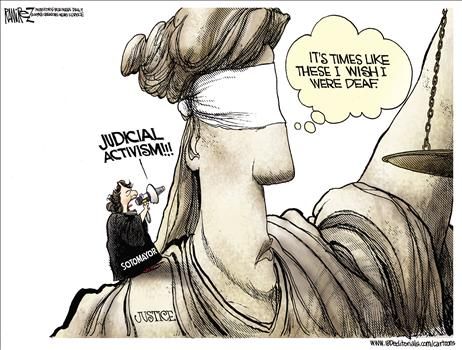
In his most recent column about Obama's nominee for the Supreme Court, Dr. Thomas Sowell compares the 'housing projects' of his (and of Sonya Sotomayor) childhood with those we know today.
As part of the biographical preoccupation with Judge Sonia Sotomayor's past, the New York Times of May 31st had a feature story on the various New York housing projects in which she and other well-known people grew up - including Whoopi Goldberg, Kareem Abdul-Jabbar, Thelonious Monk and Mike Tyson.
There was a map of New York City and dots pin-pointing the location of the project in which each celebrity grew up. As an old New Yorker, I was struck by the fact that not one of the 20 celebrities shown grew up in a housing project in Harlem!
The housing projects in which they grew up were different in another and more fundamental way. As the New York Times put it: "These were not the projects of idle, stinky elevators, of gang-controlled stairwells where drug deals go down." In other words, these were public housing projects of an earlier era, when such places were very different from what we associate with the words "housing project" today.
Just the reference to unlocked doors on the apartments there, so that children could more easily visit playmates in nearby apartments on Saturday mornings to watch television, creates an image that must seem like something out of another world to those familiar only with the housing projects of today.
There were standards for getting into the projects of those days and, if you didn't live up to those standards, they put you out. Kareem Abdul-Jabbar was quoted as saying, "When kids played on the grass, their parent would get a warning." That seems almost quaint when you think of what has gone on in the housing projects of a later era.
Since there has been so much talk of putting some of Sonia Sotomayor's inflammatory words "in context," perhaps we should put her personal life in context, if the media insist on making her personal life a factor in her nomination to the Supreme Court. While she grew up in a public housing project, the words "housing project" in that era did not mean anything like the housing projects of today.
A relative of mine lived in one of the housing projects back then - and we were proud of him, as well as glad for him, because such places were for upright citizens in those days - working class people with steady jobs and good behavior. Clever intellectuals had not yet taught us to be "non-judgmental" about misbehavior or to make excuses for vandalism and crime.
While Sonia Sotomayor was not born with a silver spoon in her mouth, let's not make her someone who rose from such depths as those conjured up by the words "housing projects" today. It is bad enough that biographical considerations carry such weight in considerations of nominees for the Supreme Court. But, if biography must be elaborated, let it at least be done "in context."
It has always made me a little uneasy when generous well-wishers have discussed my educational background as if it was something almost miraculous that I came out of the schools in Harlem and went on to Ivy League institutions. But any number of other people did exactly the same thing.
The Harlem schools of that era were no more like the Harlem schools of today than the housing projects of that era were like today's housing projects. They had classes grouped by ability and, if you were serious about getting a good education, you could get into one of the classes for kids who were serious and receive an education that would prepare you to go on in life.
There is a lot to ponder about why both the schools and the housing projects degenerated so much after the bright ideas of the 1960s intelligentsia spread throughout society, leaving social havoc in their wake.
Too many people who rose to where they are today because of a foundation of traditional values have become enthralled by the very different ideas prevalent in the elite intellectual circles to which they moved. Judge Sotomayor seems to be one of those, with her ideas about race and the policy-making role of judges.
It is bad enough that so many of those "advanced" ideas have undermined for others the foundation that Sonia Sotomayor had as she grew up, despite being raised in a home with a modest income. There is no need to let her use the Supreme Court to destroy more of those traditional American values.

"We're Sorry..."

"What Were You Thinking?"