Monday, June 29, 2009

8 GOP Votes Paved Way for "Cap And Tax" Bill

President Barack Obama and House Speaker Nancy Pelosi scored a major victory with the House's approval of a landmark climate bill -- thanks to a little help from a handful of Republicans.
 
Friday's vote was 219-212. The legislation was supported by 211 Democrats and eight aisle-crossing GOP members: Reps. Mary Bono (Calif.), Michael Castle (Del.), Mark Kirk (Ill.), Leonard Lance (N.J.), Frank LoBiondo (N.J.), John McHugh (N.Y.), David Reichert (Wash.) and Christopher Smith (N.J.). Forty-four Democrats voted against the bill, making the eight GOP votes all the more crucial.
 
"This is the biggest job-killing bill that's ever been on the floor of the House of Representatives. Right here, this bill," House Minority Leader John Boehner said after the vote. "And I don't think that's what the American people want."
The 1,200-plus-page bill now goes to the Senate, where it faces an uncertain future.
 
According to The Associated Press, the "cap-and-trade" legislation places the first national limits on emissions of heat-trapping gases from major sources like power plants, refineries and factories. It requires:
  •  An 17 percent cut in greenhouse gas emissions by 2020.
  •  An 83 percent cut in greenhouse gas emissions by 2050.
  •  That 20 percent of all electricity in the United States be generated by renewable sources and/or more efficient methods by 2020.
As written, the bill will cost American households an estimated $175 a year by 2020, according to the Congressional Budget Office.
 
Many Republicans refer to the legislation as a "national energy tax."
 
© 2009 Newsmax. All rights reserved.
 

Saturday, June 13, 2009

The Market Driven Church

Udo W. Middelmann has written a book entitled The Market Driven Church, subtitled The Worldly Influence of Modern Culture on the Church in America. Having grown up in post-W.W.II Europe, he brings a fresh perspective to a discussion of the church in particular, and our postmodern, post-Christian culture in general.
 
Chapter 3 is titled Lemonade with Too Much Water. Middelmann discusses the many changes within society and the church, and suggests that where the church once influenced society, the reverse has now become the predominant modality.  After pointing out problems both on the left and right, liberal and conservative, and positing a religion that has become more personal than public ("The personalization of Christianity weakens the emphasis on the need to bow before the reality of God, our sin, and Jesus Christ as Lord and Savior.") And then these very timely comments:
Our age has largely replaced real discussions of theological, philosophical, and cultural content with "personal" testimony, anecdotal experience, and private views.
and this:
    External factors have also contributed to the decline in the holding of truth.  Even agreement that we have the Word of God in the Bible does not prevent modern notions of what is true from doing great harm.  One of these is the modern concept of democracy, which has affected our understanding of what is true.  Once it was held that submitting all matters to the consent of the governed required an acceptance of a corresponding responsibility by the voters.  They must be critical, informed, moral, and accountable.  Where this is not the case, democracy will no longer bring an educated and moral consent.  Law will follow a mathematical win/lose situation.  Numbers can win a count, but not always an argument. 
    Majorities do not by necessity have moral integrity.  They only tell us the size, not the character, of the followers. The majority/minority relation tells us something numerical only. Without an outside definition of what is good, right, and beautiful, democracy will only indicate what is more or less accepted.  In the end, what separates the minority from the acceptable is a matter of numbers, not greater wisdom, moral rectitude, etc.
I think Mr. Middelmann has hit the nail directly upon the head. I think we can, in light of the current state of our country, make more than a few inferences from and about our culture.
  • We have become less interested in knowing the truth about issues than in winning the day with whatever argument we have chosen to accept.
  • Many of us accept and hold to a position not because we've studied it and found it to be true and in accord with reality but because it "feels right" to us.
  • We have as a society become increasingly crass and mean-spirited about those with whom we disagree.
  • The people we choose to serve us in public office are increasingly less concerned with issues truth, of right and wrong, but are more interested in remaining in office for personal power and pursuit of their own private agenda.
  • In these pursuits, numbers suit them better than do the correctness of their issues
  • Likewise, an aroused but basically ignorant public is more easily swayed by the use of rhetoric.
Ron Kohlin

  My Facebook Page
 
Ron's Rec Room website
"
What Were You Thinking?"
  My
Proton Blog
  Our
Alaska Trip Blog 
 

Sunday, June 7, 2009

Out of Context, Part III

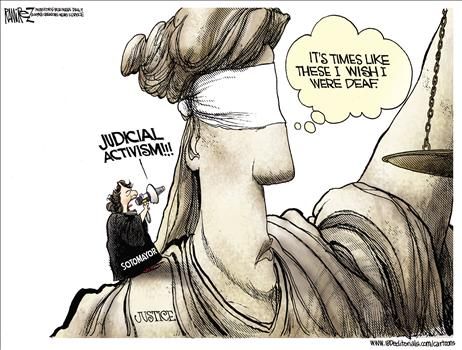
In his most recent column about Obama's nominee for the Supreme Court, Dr. Thomas Sowell compares the 'housing projects' of his (and of Sonya Sotomayor) childhood with those we know today.
As part of the biographical preoccupation with Judge Sonia Sotomayor's past, the New York Times of May 31st had a feature story on the various New York housing projects in which she and other well-known people grew up - including Whoopi Goldberg, Kareem Abdul-Jabbar, Thelonious Monk and Mike Tyson.
There was a map of New York City and dots pin-pointing the location of the project in which each celebrity grew up. As an old New Yorker, I was struck by the fact that not one of the 20 celebrities shown grew up in a housing project in Harlem!
The housing projects in which they grew up were different in another and more fundamental way. As the New York Times put it: "These were not the projects of idle, stinky elevators, of gang-controlled stairwells where drug deals go down." In other words, these were public housing projects of an earlier era, when such places were very different from what we associate with the words "housing project" today.
Just the reference to unlocked doors on the apartments there, so that children could more easily visit playmates in nearby apartments on Saturday mornings to watch television, creates an image that must seem like something out of another world to those familiar only with the housing projects of today.
There were standards for getting into the projects of those days and, if you didn't live up to those standards, they put you out. Kareem Abdul-Jabbar was quoted as saying, "When kids played on the grass, their parent would get a warning." That seems almost quaint when you think of what has gone on in the housing projects of a later era.
Since there has been so much talk of putting some of Sonia Sotomayor's inflammatory words "in context," perhaps we should put her personal life in context, if the media insist on making her personal life a factor in her nomination to the Supreme Court. While she grew up in a public housing project, the words "housing project" in that era did not mean anything like the housing projects of today.
A relative of mine lived in one of the housing projects back then - and we were proud of him, as well as glad for him, because such places were for upright citizens in those days - working class people with steady jobs and good behavior. Clever intellectuals had not yet taught us to be "non-judgmental" about misbehavior or to make excuses for vandalism and crime.
While Sonia Sotomayor was not born with a silver spoon in her mouth, let's not make her someone who rose from such depths as those conjured up by the words "housing projects" today. It is bad enough that biographical considerations carry such weight in considerations of nominees for the Supreme Court. But, if biography must be elaborated, let it at least be done "in context."
It has always made me a little uneasy when generous well-wishers have discussed my educational background as if it was something almost miraculous that I came out of the schools in Harlem and went on to Ivy League institutions. But any number of other people did exactly the same thing.
The Harlem schools of that era were no more like the Harlem schools of today than the housing projects of that era were like today's housing projects. They had classes grouped by ability and, if you were serious about getting a good education, you could get into one of the classes for kids who were serious and receive an education that would prepare you to go on in life.
There is a lot to ponder about why both the schools and the housing projects degenerated so much after the bright ideas of the 1960s intelligentsia spread throughout society, leaving social havoc in their wake.
Too many people who rose to where they are today because of a foundation of traditional values have become enthralled by the very different ideas prevalent in the elite intellectual circles to which they moved. Judge Sotomayor seems to be one of those, with her ideas about race and the policy-making role of judges.
It is bad enough that so many of those "advanced" ideas have undermined for others the foundation that Sonia Sotomayor had as she grew up, despite being raised in a home with a modest income. There is no need to let her use the Supreme Court to destroy more of those traditional American values.

"We're Sorry..."

"What Were You Thinking?"

Thursday, June 4, 2009

Wednesday, June 3, 2009

Out of Context, Part II

June 3rd brings another fact-filled, hard-hitting column from Thomas Sowell on 'the context' of Sonya Sotomayor's racial comments.  We have to ask, is your personal story of more value than mine? Why?  Sotomayor didn't thank the government for it's affirmative action programs when she accepted the nomination, but implies that she will support such programs for people like herself.  Is that the function of Supreme Court judges?  Are they to decide cases based on the law, or are they to make decisions based on their own personal biases?  Is a liberal bias of more value than a conservative bias?  Which is true to the constitution?  What about the ideas of racial and sexual diversity - do these ideas bring us closer as Americans, or do they drive wedges between people?
    As the mainstream media circles the wagons around Judge Sonia Sotomayor, to protect her from the consequences of her own words and deeds, its main arguments are distractions from the issue at hand. A CNN reporter, for example, got all worked up because Rush Limbaugh had used the word "racist" to describe the judge's words.
    Since it has been repeated like a mantra that Judge Sotomayor's words have been "taken out of context," let us look at Rush Limbaugh in context. The cold fact is that Rush Limbaugh has not been nominated to sit on the highest court in the land, with a lifetime appointment, to have the lives and liberties of 300 million Americans in his hands.
    Whatever you may think about his choice of words, those words and the ideas behind them do not change the law of the land. The words and actions of Supreme Court justices do. Anyone who doesn't like what Rush Limbaugh says can simply turn off the radio or change the station. But you cannot escape the consequences of Supreme Court decisions. Nor will your children or grandchildren.
    What does it say about a nominee to the Supreme Court that the most that her defenders can say in her defense is that her critics used words that her defenders don't like?
    What does it say about her qualifications to be on the Supreme Court when her supporters' biggest talking points are that she had to struggle to rise in the world?
    Bonnie and Clyde had to struggle. Al Capone had to struggle. The only President of the United States who was forced to resign for his misdeeds - Richard Nixon - had to struggle. For that matter, Adolf Hitler had to struggle! There is no evidence that struggle automatically makes you a better person.
    Sometimes, instead of making you appreciative of a society in which someone born at the bottom can rise to the top, it leaves you embittered that you had to spend years struggling, and resentful of those who were born into circumstances where the easy way to the top was open to them.
    Much in the past of Sonia Sotomayor, and of the president who nominated her, suggests such resentments. Both have a history of connections with people who promoted resentments against American society. La Raza ("the race") was Judge Sotomayor's Jeremiah Wright. If context is important, then look at that context.
    Sonia Sotomayor has, in both her words and in her decision as a judge to dismiss out of hand the appeal of white firefighters who had been discriminated against, betrayed a racism that is no less racism because it is directed against different people than the old racism of the past.
    The code word for the new racism is "diversity." The Constitution of the United States says nothing about diversity and the Constitution is what a judge is supposed to pay attention to, not the prevailing buzzwords of the times.
    What the Constitution says is "equal protection of the laws" for all Americans - and that is not taken out of context. People have put their lives on the line to make those words a reality. Now all of that is to be made to vanish into thin air by saying the magic word "diversity."
    The landmark Civil Rights Act of 1964, like the Constitution, proclaimed equal rights for all, not special rights for those for whom judges have "empathy."
    When the Civil Rights Act of 1964 was being debated in Congress, its opponents claimed that it would lead to discrimination against white people. Its supporters declared that it meant no such thing and added new provisions to make sure that it meant no such thing. That was the law that was passed.
    It was not the law, but the judges, who changed equal rights into special rights and thereby set the stage for the new mantra of "diversity" that trumps equal rights. Diversity was Judge Sotomayor's rationale for going along with the denial of equal rights for white firefighters in Connecticut.
    When all else fails, supporters of Judge Sotomayor say that she is Hispanic and a woman, and that it would be politically dangerous to deny her a place on the Supreme Court. This is as much an insult to the intelligence of Hispanic and female voters as it is to the Constitution of the United States and to those who put their lives on the line for equal rights.

Out of Context

On June 2nd, Thomas Sowell penned yet another column regarding Barack Obama's nominee for the Supreme Court.  Pointing out the hypocritical double standard employed by the left in supporting Ms. Sotomayor, Mr. Sowell makes cogent material points rather than employing ad hominum attacks..
    In Washington, the clearer a statement is, the more certain it is to be followed by a "clarification" when people realize what was said. The clearly racist comments made by Judge Sonia Sotomayor on the Berkeley campus in 2001 have forced the spinmasters to resort to their last-ditch excuse, that it was "taken out of context."
    If that line is used during Judge Sotomayor's Senate confirmation hearings, someone should ask her to explain just what those words mean when taken in context.
    What could such statements possibly mean - in any context - other than the new and fashionable racism of our time, rather than the old-fashioned racism of earlier times? Racism has never done this country any good, and it needs to be fought against, not put under new management for different groups.
    Looked at in the context of Judge Sotomayor's voting to dismiss the appeal of white firefighters who were denied the promotions they had earned by passing an exam, because not enough minorities passed that exam to create "diversity," her words in Berkeley seem to match her actions on the judicial bench in the 2nd Circuit Court of Appeals all too well.
    The Supreme Court of the United States thought that case was important enough to hear it, even though the three-judge panel on which Judge Sotomayor served gave it short shrift in less than a page. Apparently the famous "empathy" that President Obama says a judge should have does not apply to white males in Judge Sotomayor's court.
    The very idea that a judge's "life experiences" should influence judicial decisions is as absurd as it is dangerous.
    It is dangerous because citizens are supposed to obey the law, which means they must know what the law is in advance - and nobody can know in advance what the "life experiences" of whatever judge they might appear before will happen to be.
    t is absurd because it flies in the face of the facts. It was a fellow Puerto Rican judge on the 2nd Circuit Court of Appeals - Jose Cabranes - who rebuked his judicial colleagues for the cavalier way they dismissed the white firefighters' case.
    On the Supreme Court, the justice whose life story is most like that of Sonia Sotomayor - Clarence Thomas - has a very different judicial philosophy from hers.
    The clever people in the media and elsewhere are saying that "inevitably" one's background influences how one feels about issues. Even if that were true, judges are not supposed to decide cases based on their personal feelings.
    Justice Oliver Wendell Holmes said that he "loathed" many of the people in whose favor he voted on the Supreme Court. Obviously, he had feelings. But he also had the good sense and integrity to rule on the basis of the law, not his feelings.
    Laws are made for the benefit of the citizens, not for the self-indulgences of judges. Making excuses for such self-indulgences and calling them "inevitable" is part of the cleverness that has eroded the rule of law and undermined respect for the law.
    Something else is said to be "inevitable" by the clever people. That is the confirmation of Sonia Sotomayor to the Supreme Court. But it was only a year and a half ago that Hillary Clinton's winning the Democratic Party's nomination for president was considered "inevitable."
    The Republicans certainly do not have the votes to stop Judge Sotomayor from being confirmed - if all the Democrats vote for her. But that depends on what the people say. It looked like a done deal a couple of years ago when an amnesty bill for illegal aliens was sailing through the Senate with bipartisan support. But public outrage brought that political steamroller to a screeching halt.
    Nothing is inevitable in a democracy unless the public lets the political spinmasters and media talking heads lead them around by the nose.
    The real question is whether the Republican Senators have the guts to alert the public to the dangers of putting this kind of judge on the highest court in the land, so that they will at least have some chance of stopping the next one that comes along.
    It would be considered a disgrace if an umpire in a baseball game let his "empathy" determine whether a pitch was called a ball or strike. Surely we should accept nothing less from a judge.

Tuesday, June 2, 2009

Five Character Flaws...

John Hawkins writes an interesting article in Townhall.com today.  Addressing the state of our American Culture, the article is titled Five Character Flaws That Are Destroying America's Future.  I wonder if these attributes are found in the peoples of other countries as well?  I suspect so; they're more likely the result of the post-Christian, Postmodern philosophy that infects the entire world.
1) Lack Of Personal Responsibility: As a society, we encourage a "victimhood mentality" and an overweening government that never met an issue it didn't want to dive into with both feet; so we shouldn't be surprised that so many Americans expect to be rewarded for failure.
    If GM fails, we've got to step in and keep it afloat. If people snuck into this country illegally, we can't be so hardhearted as to obey the law and deport them! If you bought a house you couldn't afford, you shouldn't be penalized for that when the market takes a bad turn. If you bought a blender, tried to start it in your bathtub, and were nearly electrocuted -- that's not your fault! The manufacturers should have put a warning sticker on it.
    We're descended from pioneer stock. Our ancestors explored, conquered, and tamed a continent. They couldn't rely on the police to show up if an Indian raiding party showed up at their isolated cabin at 3 AM. There was no school lunch program on the Oregon Trail. If your buggy whip company was going out of business because of those new fangled auto-mo-biles, you didn't get 20 billion dollars in taxpayer money so you could open up a new branch in China, you went out of business. If our ancestors were alive, they would sneer in disdain at what a nation full of whining babies their descendants have become.
 
2) Short Attention Spans: Perhaps because of the internet, the stunning variety of news sources, or the complexity of modern society, we've become much less able as a people to follow logical arguments and deal with complex messages.
    This has bled over into Congress where they write legislation dealing with issues they don't truly understand. That legislation is voted on by legislators who admit that they haven't read it and it affects the lives of millions of people who were unaware that such legislation was even being contemplated.
    The problem with this is that there are many issues in life that are too knotty to be broken down into a soundbite or a 30 second commercial. Those affairs require more extensive knowledge and deeper thought and consideration than can be placed on a bumper sticker or weaved into a music video. When we lose sight of that fact, utter disasters that have been in plain sight all along for anyone with an attention span longer than five minutes can blindside much of the population.
 
3) Excessive Self-Esteem: Perhaps because we've spent decades trying to pump up the self-esteem of children in our public schools, irregardless of whether they've done anything to merit it, we have legions of people in our society who have an excessive level of confidence in their beliefs and abilities.
    They're just so darn sure that what they believe is right just by virtue of the fact they believe it. Traditions? Codes of conduct? Religious beliefs? Customs? There's no need to even understand why previous generations believed what they did or to question what purpose it served. Just remember that they were racist back then and so they couldn't have had any good ideas.
    Of course, we don't look back and say, "Gee? How did they make it without welfare, social security, or an income tax? Why is it that they had a divorce rate that was a fraction of the one we had today? How is it that the crime rate was so much lower? What made the people so much more polite than they are today? If we were in the same situation as the Founding Fathers, could our political leaders step up to the plate and do as well?"
    Because we have forgotten the mistakes that convinced our forefathers to adopt the policies and mores that they did, in our ignorance we will be doomed to make many of those same mistakes again.
 
4) Short Term Thinking/Instant Gratification: Thomas Sowell once said that killing the goose that laid the golden egg can be a viable election strategy as long as it doesn't die until you're out of office and no one finds your prints on the murder weapon.
    That is played out in American politics on a daily basis where few politicians think farther ahead than the next election. Time and time again, we have politicians advocating policies that either bring immediate benefits or avoid short-term pain, but are extremely harmful to the country over the long-term.
    That is primarily how government has gotten so out of control. A problem occurs. In an effort to get re-elected, politicians rush to create a program to "fix" it. Ten years later, the original problem may or may not have been solved, but the program put in place to "fix" it has caused new issues and costs five times more than it did when it was originally put into place. However, if anyone suggests we get rid of it, there are howls of outrage. Hence, government never shrinks and bad programs almost never die.
 
5) Immorality: The default mode of Hollywood is hedonism and we've been told again and again, at least since the Clinton years, that character doesn't matter for our elected officials.
    The problem with this is that character does matter -- quite a bit, actually.
    Our leaders are corrupt to the core -- and that's not just the ones who are in violation of our laws, which have been crafted in order to allow staggering amounts of corruption to be done legally. The families of politicians are given plum jobs and paid ridiculous sums of money in order to gain influence with legislators. Government earmarks that aid campaign contributors or family members of Congress are common. Chrysler has even been handed over to Barack Obama's union allies in broad daylight. Ethics have become the very last consideration for our government and perhaps it's no surprise given the state of our society.
    Civility is dead and buried. We have people protesting funerals and the private residences of citizens. There are perverted gay parades in the streets of San Francisco. The most grotesque, blasphemous, and offensive material imaginable is regularly displayed on the internet and TV and we are drenched in sex from the time we get up until the time we go to bed.
    As a replacement for actual human decency and morality, we've turned to political correctness and bloodless legalisms, neither of which is an adequate replacement for doing the right thing because it's principled or virtuous.
    The corrosive effects of this decline are seen not just in our government, but all throughout our society in the size of our prison population, the number of unmarried women having children, drug use, school shootings, and even our staggering abortion rate.
The comments following the article are instructive, as well. Read the article and comments HERE.
 

Monday, June 1, 2009

'Empathy' In Action

The values of a judge with "emapthy" is presented by Dr. Thomas Sowell. How can a judge be true to the law, and at the same time give special, 'empethetic' consideration to some privileged individuals or groups?
     It is one of the signs of our times that so many in the media are focusing on the life story of Judge Sonia Sotomayor, President Obama's nominee for the Supreme Court of the United States.
    You might think that this was some kind of popularity contest, instead of a weighty decision about someone whose impact on the fundamental law of the nation will extend for decades after Barack Obama has come and gone.
    Much is being made of the fact that Sonia Sotomayor had to struggle to rise in the world. But stop and think.
    If you were going to have open heart surgery, would you want to be operated on by a surgeon who was chosen because he had to struggle to get where he is or by the best surgeon you could find - even if he was born with a silver spoon in his mouth and had every advantage that money and social position could offer?
    If it were you who was going to be lying on that operating table with his heart cut open, you wouldn't give a tinker's damn about somebody's struggle or somebody else's privileges.
    The Supreme Court of the United States is in effect operating on the heart of our nation - the Constitution and the statutes and government policies that all of us must live under.
    Barack Obama's repeated claim that a Supreme Court justice should have "empathy" with various groups has raised red flags that we ignore at our peril— and at the peril of our children and grandchildren.
    "Empathy" for particular groups can be reconciled with "equal justice under law" - the motto over the entrance to the Supreme Court - only with smooth words. But not in reality. President Obama used those smooth words in introducing Judge Sotomayor but words do not change realities.
    Nothing demonstrates the fatal dangers from judicial "empathy" more than Judge Sotomayor's decision in a 2008 case involving firemen who took an exam for promotion. After the racial mix of those who passed that test turned out to be predominantly white, with only a few blacks and Hispanics, the results were thrown out.
    When this action by the local civil service authorities was taken to court and eventually reached the 2nd Circuit Court of Appeals, Judge Sotomayor did not give the case even the courtesy of a spelling out of the issues. She backed those who threw out the test results. Apparently she didn't have "empathy" with those predominantly white males who had been cheated out of promotions they had earned.
        Fellow 2nd Circuit Court judge Jose Cabranes commented on the short shrift given to the serious issues in this case. It so happens that he too is Hispanic, but apparently he does not decide legal issues on the basis of "empathy" or lack thereof.
    This was not an isolated matter for Judge Sotomayor. Speaking at the University of California at Berkeley in 2001, she said that the ethnicity and sex of a judge "may and will make a difference in our judging."
    Moreover, this was not something she lamented. On the contrary, she added, "I would hope that a wise Latina woman with the richness of her experiences would more often than not reach a better conclusion than a white male who hasn't lived that life."
    No doubt the political spinmasters will try to spin this to mean something innocent. But the cold fact is that this is a poisonous doctrine for any judge, much less a justice of the Supreme Court.
    That kind of empathy would for all practical purposes repeal the 14th Amendment to the Constitution of the United States, which guarantees "equal protection of the laws" to all Americans.
    What would the political spinmasters say if some white man said that a white male would more often reach a better conclusion than a Hispanic female?
    For those who believe in the rule of law, Barack Obama used the words "rule of law" in introducing his nominee. For those who take his words as gospel, even when his own actions are directly the opposite of his words, that may be enough to let him put this dangerous woman on the Supreme Court.
    Even if her confirmation cannot be stopped, it is important for Senators to warn of the dangers, which will only get worse if such nominations sail through the Senate smoothly.

Saturday, May 30, 2009

Presidential Oath of Office

Each president recites the following oath, in accordance with Article II, Section I of the U.S. Constitution:
"I do solemnly swear (or affirm) that I will faithfully execute the office of President of the United States, and will to the best of my ability, preserve, protect and defend the Constitution of the United States."
Read the Constitution of the United States, to see what the current occupant of the Oval Office has sworn (or affirmed) to preserve, protect and defend.

"What Were You Thinking?"

Sotomayor: Judges make Policy

Wednesday, May 27, 2009

Oath of Office for Federal Judges

In the United States, federal judges are required to take not just one, but two oaths. The first oath is this:
I, [Name], do solemnly swear (or affirm) that I will administer justice without respect to persons, and do equal right to the poor and to the rich, and that I will faithfully and impartially discharge and perform all the duties incumbent upon me as [appointed position] under the Constitution and laws of the United States. So help me God.
The second oath that federal judges must take is this:
I, [Name], do solemnly swear (or affirm) that I will support and defend the Constitution of the United States against all enemies, foreign and domestic; that I will bear true faith and allegiance to the same; that I take this obligation freely, without any mental reservation or purpose of evasion; and that I will well and faithfully discharge the duties of the office on which I am about to enter. So help me God.
Emphasis added; draw your own conclusions.  Please also note that the Constitution says nothing about having empathy for any particular group that might come before the court.  It does mention the Law - which is to be enacted by Congress and approved by the President.
 

Waxman-Markey

Monday's "Morning Bell" from the Heritage Foundation:
    Today the House Energy and Commerce Committee will begin a multi-day markup on the Waxman-Markey energy tax bill. Committee Chairman Henry Waxman (D-CA) has been busy lobbying his own caucus for the necessary 30 votes to get the bill out of committee for weeks, but the bill's fate is still in doubt. Considering that global warming legislation is a cornerstone of President Barack Obama's agenda (he needs the tax revenues to fund his other big spending priorities), why can't the Obama administration convince their own party that their energy tax is a good deal for the American people?
    First let's look at the economic costs of Waxman-Markey. Waxman-Markey attempts to limit greenhouse gas emissions by making it more expensive for greenhouse gas emitters to operate. Instead of a direct tax on greenhouse emissions, Waxman-Markey issues permits (mostly for free but some at a price paid to the federal government) that allow businesses to emit greenhouse gasses. Businesses that fail to lobby the federal government for enough permits to cover their current emission levels will then have to buy them from either the federal government or other businesses that have better lobbyists in Washington, DC.
    The net effect of these permits is higher costs for businesses and consumers that emit greenhouse gasses, the most prevalent being CO2. As then-candidate Barack Obama explained to the San Francisco Chronicle, this policy will cause electricity prices to "skyrocket." Since everything you consume requires energy, the higher energy costs caused by Waxman-Markey will spread throughout the entire economy. The Heritage Foundation's Center for Data Analysis has crunched the numbers and found that by 2035, last week's version of Waxman-Markey would: 1) reduce aggregate gross domestic product (GDP) by $7.4 trillion; 2) destroy 844,000 jobs on average; and 3) raise an average family's annual energy bill by $1,500. And this week's version of the bill appears to have an even greater catastrophic effect on the economy.
    That's a pretty steep cost. So what do Americans get for being $7.4 trillion poorer in 2035? Other environmental legislation has helped reduce acid rain and slow the growth of asthma, so Waxman-Markey must offer some tangible benefits to the American people right? Wrong. Waxman-Markey is a truly unique piece of environmental legislation in that it does not offer a single tangible benefit to the American people.
    Global warming is just that: global. The United States still has the largest economy in the world, but China is now the world's largest emitter of greenhouse gasses. India also has a rapidly growing economy and neither they, nor China, have any plans to reduce their carbon emissions. So, using the left's own global warming theory, how much would Waxman-Markey actually cool the earth? Climatologist Chip Knappenberger crunched the numbers and found that even the strictest version of Waxman-Markey would reduce projected global temperatures by just 0.044ºC by 2050. That is less than one-tenth of one degree.
    So as this week progresses, and you hear scary story after scary story of all the hurricanes, wildfires, and flooding that will occur because of global warming, remember this: according to the left's own computer models Waxman-Markey would not prevent any of it.

Tuesday, May 26, 2009

Chicago Tribune cartoon - 1934

Doesn't this look a more than a little bit like what we're going through right now?

Sunday, May 24, 2009

Lest We Forget...

God of our fathers, known of old--
Lord of our far-flung battle line--
Beneath whose awful hand we hold
Dominion over palm and pine--
Lord God of Hosts, be with us yet,
Lest we forget--lest we forget!
 
The tumult and the shouting dies--
The Captains and the Kings depart--
Still stands Thine ancient sacrifice,
An humble and a contrite heart.
Lord God of Hosts, be with us yet,
Lest we forget--lest we forget!
 
Far-called our navies melt away--
On dune and headland sinks the fire--
Lo, all our pomp of yesterday
Is one with Nineveh and Tyre!
Judge of the Nations, spare us yet,
Lest we forget--lest we forget!
 
If, drunk with sight of power, we loose
Wild tongues that have not Thee in awe--
Such boastings as the Gentiles use,
Or lesser breeds without the Law--
Lord God of Hosts, be with us yet,
Lest we forget--lest we forget!
 
For heathen heart that puts her trust
In reeking tube and iron shard--
All valiant dust that builds on dust,
And guarding calls not Thee to guard.
For frantic boast and foolish word,
Thy Mercy on Thy People, Lord!
Amen.
 
-- Rudyard Kipling

Tuesday, May 12, 2009

Abraham Lincoln's Thoughts


Perhaps we should consider Lincoln's words in light of what the present administration is doing to our country.

Monday, May 11, 2009

From Whence doth the Liberal Issue?

Article today at Townhall.com, by Bert Prelutsky, a former Liberal who lives in California:
    I used to be what I thought was a liberal. If, at the time, anyone had asked me to explain myself, I would have said that I opposed Jim Crow laws, that I believed workers were entitled to make a decent wage and work in a safe environment, and that American citizens shouldn't be discriminated against because of their race, religion or national origin.
    I quit being a liberal because I didn't believe that members of particular minority groups deserved advantages denied to others, that illegal aliens weren't entitled to anything but a swift kick to the backside, that being a devout Christian didn't make you a bad person, and that capitalism was a system that worked, while socialism not only didn't work but most often turned into tyranny.
    I honestly don't know why there are so many liberals today and I certainly can't imagine why they have such a lousy agenda. I have come up with a theory. Here in California, roughly 30 years ago, because of budget cuts, a great many people were released from insane asylums. They wound up living in the streets, which explains the large number of homeless people, even though Democrats would have you believe that those are normal people who simply lost their jobs along the way.
    Even after the state became more solvent, it became almost impossible to get these poor souls back into institutions where they could be fed, clothed and given their meds, because the ACLU lawyers fought for their inalienable right to starve, freeze and use the sidewalks of your city as their combination bedroom, living room and bathroom.
    Inevitably, they also got to vote. As a result, the likes of Barbara Boxer, Dianne Feinstein, Gray Davis, Arnold Schwarzenegger, Antonio Villaraigosa, Gavin Newsom and Jerry Brown, wound up winning all the major elections. I mean, the truth is, you'd have to be crazy to vote for those people.
    I have to suspect that a similar scenario took place all over the country. How else to explain that two-thirds of Americans actually believe that Barack Obama's policies will save our economy? I'm not even a Christian, but I find it bizarre that people who pooh-pooh the idea that Christ raised the dead or walked on water are totally convinced that a guy who's tossing trillions of dollars into the air is a financial miracle worker. Talk about blind faith!
    It makes me wonder if these same people, were they facing personal bankruptcy, would think that the answer to their own financial difficulties would be to give their wife an American Express card and drop her off at Tiffany's.
    If liberals aren't simply insane, they surely must be hypocrites. Why else would they insist that spending eight years bashing President Bush and comparing him, Dick Cheney and Donald Rumsfeld, to the Nazi High Command was patriotic, but merely questioning President Obama's qualifications, judgment and policies makes one a racist?
    How is it that when, between 2000 and 2006, when the GOP had control of the Oval Office, the House and the Senate, on those rare occasions they didn't do the bidding of Ted Kennedy, John Murtha or Charles Schumer, they were condemned as divisive? However, when Obama and his left-wing cronies rushed through a trillion dollar stimulus package and a pork-filled budget over Republican objections, nobody in their crowd cried "Foul!" or insisted on reaching across the aisle for a group hug and a few choruses of "Kumbaya"?
    Before anyone bothers sending an e-mail reminding me that three Republican senators voted with the Democrats on the stimulus bill, I haven't forgotten. But, let's face it -- the two ladies from Maine are merely the east coast version of Boxer and Feinstein. As for Arlen Specter, I suspect that along the way, he'll switch to the Extraterrestial Party if, as he inches closer to being a hundred years old, he decides that's his best chance of winning an election.
    I know that people such as Sen. Specter and Sen. Jeffords would have us believe that they switched parties because of their principles, but I would prefer it if they only said such silly things in the hope of making me laugh. That's because I love to laugh, but I hate being taken for a fool. I mean, really, Jim Jeffords wakes up one day when he's 67 years old and Specter opens his eyes at the age of 79 and suddenly decide that the GOP isn't as conservative as they'd like, so the solution is to link left arms with the likes of Nancy Pelosi, Harry Reid, Chris Dodd and Barney Frank?
    Something else that makes me wonder if, in a nicer, kinder world, liberals wouldn't be housed in a warm place where they'd be kept safely away from sharp objects and voting booths, is their notion of what constitutes torture. In my world, cutting off Daniel Pearl's head, throwing Anne Frank in an oven or having to listen to Chris Matthews, is torture. But by no means is it playing loud music, keeping people awake, making them share space with a caterpillar or even dousing them with water, in order to get them to cough up information that might prevent another 9/11 or keep American soldiers from being ambushed.
    Only a liberal could confuse actual torture with college hazing. I suspect there are members of fraternities who could share more harrowing tales than the Islamics with their Korans, their three squares and their personal prayer mats at Gitmo.
    Another difference that seems to escape liberals is that it's torture when the only purpose is to cause pain, not when it's done in order to pry important information from terrorists.
    And, finally, when did liberals decide that homosexuals get the final word when it comes to matters of morals, values or anything else, for that matter?
    It's bad enough that any number of self-righteous academics kept military recruiters off college campuses, pretending that their objection stemmed from the army's don't ask/don't tell policy, and not simply because left-wingers hate anything and everything that smacks of patriotism.
    In much the same way, those on the Left have led a crusade against the Boy Scouts of America because, so they say, they oppose the policy of not allowing homosexuals to be Scout leaders and take young boys into the woods on camping trips. Sensible people regard that as a sensible policy. It's not to suggest that every gay man is a pedophile, but simply recognizing that most pedophiles are gay men. Just as every Muslim is not a terrorist, just about every terrorist these days is a Muslim. So, why should parents take any unnecessary chances with their most precious possessions just so homosexuals won't have their feelings hurt?
    Liberals don't really care about homosexuals, by the way, unless they themselves happen to be gay. The truth is liberals rarely serve in the military now that service is voluntary and they don't usually let their kids join the Boy Scouts, not because they're offended by the aforementioned policy, but because the group fosters faith-based and patriotic ideals.
    If you want a perfect example of liberal hypocrisy, consider the recent beauty pageant when a repulsive little freak who calls himself Perez Hilton (born Mario Lavenderia), who had no business even being on stage at a competition involving beautiful women, got to ask Miss California, Carrie Prejean, how she felt about same-sex marriages. Her honest answer probably cost her the victory, while earning her the respect of most fair and decent Americans.
    What I find so telling about the incident was that in California, the reason that the same-sex marriage measure was defeated on the November ballot was because 70% of blacks voted that way. But the gays only demonstrated outside Catholic and Mormon churches and businesses. Furthermore, I guarantee that if Miss Prejean had been black, instead of a blue-eyed blonde, Mr. Hilton wouldn't have dared open his ugly little yap.
    It's also worth noting that President Obama gave the exact same answer to the exact same question during the campaign, and yet the gays voted overwhelmingly for him. Which certainly suggests that, thanks to the insane asylums being relatively empty these days, honesty can cost you a tiara, but not the presidency.

"Empathy" versus Law, Part IV

In his fourth column in a series on activist juciciary, Thomas Sowell talks about the leftist, "Big Government" agenda being pushed by the current occupant of the Oval Office:
    While President Barack Obama has, in one sense, tipped his hand by saying that he wants judges with "empathy" for certain groups, he has in a more fundamental sense concealed the real goal - getting judges who will ratify an ever-expanding scope of the power of the federal government and an ever-declining restraint by the Constitution of the United States.
    This is consistent with everything else that Obama has done in office and is consistent with his decades-long track record of alliances with people who reject the fundamentals of American society.
    Judicial expansion of federal power is not really new, even if the audacity with which that goal is being pursued may be unique. For more than a century, believers in bigger government have also been believers in having judges "interpret" the restraints of the Constitution out of existence.
    They called this "a living Constitution." But it has in fact been a dying Constitution, as its restraining provisions have been interpreted to mean less and less, so that the federal government can do more and more.
    For example, the Constitution allows private property to be taken for "public use" - perhaps building a reservoir or a highway - if "just compensation" was paid. But that power was expanded by the Supreme Court in 2005 when it "interpreted" this to mean that private property could be taken for a "public purpose," which could include almost anything for which politicians could come up with the right rhetoric.
    As for "just compensation," that is often about as just as "separate but equal" was equal. As for "empathy" for the less fortunate, it is precisely lower income and minority neighborhoods that are disproportionately bulldozed to make way for upscale shopping and entertainment centers that will bring in more taxes for politicians to spend to get themselves re-elected.
    This process of "interpreting" the Constitution (or legislation) to mean pretty much whatever you want it to mean, no matter how plainly the words say something else, has been called judicial activism. But, as a result of widespread objections to this, that problem has been solved by redefining "judicial activism" to mean something different.
    By the new definition, a judge who declares legislation that exceeds the authority of the legislature unconstitutional is called a "judicial activist."
    The verbal virtuosity is breathtaking. With just a new meaning to an old phrase, reality is turned upside down. Those who oppose letting government actions exceed the bounds of the Constitution - justices like Antonin Scalia and Clarence Thomas - are now called "judicial activists." It is a verbal coup.
    Not only politicians like Senator Patrick Leahy, but also law professors like Cass Sunstein and many in the media, measure how much of a judicial activist a judge is by how many laws that judge has declared unconstitutional. Professor Sunstein, incidentally, is among those being mentioned as a possible nominee for a post on the Supreme Court.
    When the Supreme Court in 1995 declared that carrying a gun near a school was not "interstate commerce," there was consternation and outrage in the liberal press because previous decisions of the Supreme Court in years past had allowed Congress to legislate on virtually anything it wanted to by saying that it was exercising its authority to regulate interstate commerce.
    When the Supreme Court decided by a narrow 5 to 4 vote that carrying a gun near a school was not interstate commerce, it was saying something that most people would consider too obvious for words. But it was considered outrageous that the Supreme Court recognized the obvious and refused to rubberstamp the sophistry that allowed Congress to pass laws dealing with things that the Constitution never authorized it to deal with.
    Incidentally, carrying a gun near a school was something that states had the authority to deal with, and the great majority of states had already banned it.
    What is at stake in Supreme Court nominations is the power of the federal government. "Empathy" is just camouflage, a soothing word for those who do not look beyond nice-sounding rhetoric.
Dr. Sowell has an excellent way of communicating the dangers posed to the constitution by this current administration.  It's a pity more people don't read and consider the things he's telling us.
 

Thursday, May 7, 2009

"Empathy" vs Law, Part III

Dr. Thomas Sowell continues his explanation of the requirements of Law - and those who would be Judges:
There is a reason why the statue of Justice wears a blindfold. There are things that courts are not supposed to see or recognize when making their decisions-- the race you belong to, whether you are rich or poor, and other personal things that could bias decisions by judges and juries.
It is an ideal that a society strives for, even if particular judges or juries fall short of that ideal. Now, however, President Barack Obama has repudiated that ideal itself by saying that he wants to appoint judges with "empathy" for particular groups.
This was not an isolated slip of the tongue. Barack Obama said the same thing during last year's election campaign. Moreover, it is completely consistent with his behavior and associations over a period of years-- and inconsistent with fundamental principles of American government and society.
Nor is this President Obama's only attempt to remake American society. Barack Obama's vision of America is one in which a President of the United States can fire the head of General Motors, tell banks how to bank, control the medical system and take charge of all sorts of other activities for which neither he nor other politicians have any expertise or experience.
The Constitution of the United States gives no president, nor the entire federal government, the authority to do such things. But spending trillions of dollars to bail out all sorts of companies buys the power to tell them how to operate.
Appointing judges to the federal courts-- including the Supreme Court-- who believe in expanding the powers of the federal government to make arbitrary decisions, choosing who will be winners and losers in the economy and in the society, is perfectly consistent with a vision of the world where self-confident and self-righteous elites rule according to their own notions, instead of merely governing under the restraints of the Constitution.
     If all this can be washed down with pious talk about "empathy," so much the better for those who want to remake America. Now that the Obama administration has a Congressional majority that is virtually unstoppable, and a media that is wholly uncritical, the chances of preventing the president from putting someone on the Supreme Court who shares his desire to turn America into a different country are slim or none.
The only thing on the side of those who understand this, and who oppose it, is time. Reshaping the Supreme Court cannot be done overnight, the way Congress passed a vast spending bill in two days.
Replacing Supreme Court justices is something that can only be done one at a time and at unpredictable intervals. What this means is that Senators who do not have enough votes to stop an Obama nominee for the High Court from being confirmed nevertheless have an opportunity - and a duty - to alert the public to the dangers of what is being done.
This does not mean turning confirmation hearings into a circus or a kangaroo court with mud-slinging at judicial nominees, the way Robert Bork and Clarence Thomas were smeared. But it also does not mean taking the path of least resistance by quietly voting for people like Ruth Bader Ginsberg and Stephen Breyer, who treat the Constitution as a grant of arbitrary power to themselves, rather than a restriction of power on the government as a whole.
It is all too easy to say "a president has a right to appoint the kind of people he wants on the Supreme Court." He does. But that does not mean that those who don't have the votes to stop dangerous nominees from being confirmed are obliged to vote for them or to stand mute.
Since Justice David Souter is likely to be replaced by another liberal, it is all too easy to say that it is no big deal. But with all the indications already as to how the Obama administration is trying to remake America on many fronts, the time to begin alerting the public to the dangers is now.
Given the age and health of other Supreme Court justices, more replacements are likely during Obama's time in the White House. Time is an opportunity to mobilize public opinion and perhaps change the composition of the Senate that confirms judicial nominees.
     But time by itself does nothing. It is what we do with time that matters.