

The Promise of Socialism Is Misery for All
11 hours ago


If the elderly are worried about the projected $500 billion cut in Medicare and Medicaid over the ensuing decade and conservatives fret over socialization of healthcare, the average American can relate most easily to the concerns over the size of the debt and the deficit that Lieberman articulates.Lieberman’s critique gives moderates a place to go in the healthcare debate. Caught in the tug between the liberals who dominate Democratic primaries and the more conservative voices that may prevail in November, centrist Democrats can rally easily around the “not now” approach of Joe Lieberman. It is obvious that, despite the Obama majorities in Congress, this is the exact wrong time to embark on a major new government spending program.
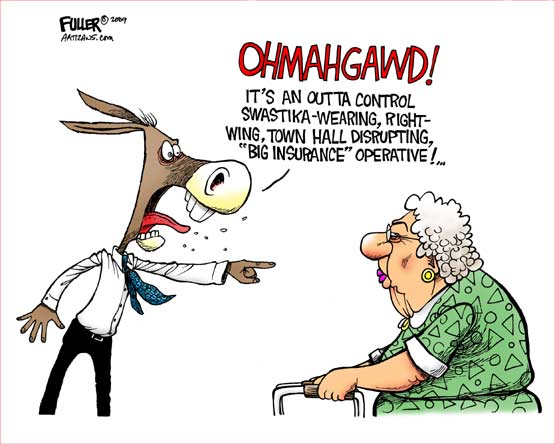
American democracy has never been democracy by plebiscite, a process by which a leader is anointed, then the populace steps out of the way, and the anointed one puts his political program in place. In the American tradition, the "mandate of heaven" is gained and lost every day and people talk back to their leaders. They are not held in thrall by them. The leaders are not infallible or a breed apart. That way is the Third World way, the way it plays out in Arab and Latin American politics.Those protesters in those town-hall meetings have served notice that Mr. Obama's charismatic moment has passed. Once again, the belief in that American exception that set this nation apart from other lands is re-emerging. Health care is the tip of the iceberg. Beneath it is an unease with the way the verdict of the 2008 election was read by those who prevailed. It shall be seen whether the man swept into office in the moment of national panic will adjust to the nation's recovery of its self-confidence.

After many a disappointment with someone, and especially after a disaster, we may be able to look back at numerous clues that should have warned us that the person we trusted did not deserve our trust.When that person is the President of the United States, the potential for disaster is virtually unlimited.Many people are rightly worried about what this administration's reckless spending will do to the economy in our time and to our children and grandchildren, to whom a staggering national debt will be passed on. But if the worst that Barack Obama does is ruin the economy, I will breathe a sigh of relief.He is heading this country toward disaster on many fronts, including a nuclear Iran, which has every prospect of being an irretrievable disaster of almost unimaginable magnitude. We cannot put that genie back in the bottle-- and neither can generations yet unborn. They may yet curse us all for leaving them hostages to nuclear terror.Conceivably, Israel can spare us that fate by taking out the Iranian nuclear facilities, instead of relying on Obama's ability to talk the Iranians out of going nuclear.What the Israelis cannot spare us, however, are our own internal problems, of which the current flap over President Obama's injecting himself into a local police issue is just a small sign of a very big danger.Nothing has torn more countries apart from inside like racial and ethnic polarization. Just this year, a decades-long civil war, filled with unspeakable atrocities, has finally ended in Sri Lanka. The painful irony is that, when the British colony of Ceylon became the independent nation of Sri Lanka in 1948, its people were considered to be a shining example for the world of good relations between a majority (the Sinhalese) and a minority (the Tamils). That all changed when politicians decided to "solve" the "problem" that the Tamil minority was much more economically successful than the Sinhalese majority. Group identity politics led to group preferences and quotas that escalated into polarization, mob violence and ultimately civil war.Group identity politics has poisoned many other countries, including at various times Kenya, Czechoslovakia, Fiji, Guyana, Canada, Nigeria, India, and Rwanda. In some countries the polarization has gone as far as mass expulsions or civil war.The desire of many Americans for a "post-racial" society is well-founded, though the belief that Barack Obama would move in that direction was extremely ill-advised, given the history of his actions and associations.This is a president on a mission to remake American society in every aspect, by whatever means are necessary and available. That requires taking all kinds of decisions out of the hands of ordinary Americans and transferring them to Washington elites-- and ultimately the number one elite, Barack Obama himself.Like so many before him who have ruined countries around the world, Obama has a greatly inflated idea of his own capabilities and the prospects of what can be accomplished by rhetoric or even by political power. Often this has been accompanied by an ignorance of history, including the history of how many people before him have tried similar things with disastrous results.During a recent TV interview, when President Obama was asked about the prospects of victory in Afghanistan, he replied that it would not be victory like in World War II, with "Hirohito coming down and signing a surrender to MacArthur." In reality, it was more than a year after Japanese officials surrendered on the battleship Missouri before Hirohito met General Douglas MacArthur for the first time.This is not the first betrayal of his ignorance by Obama, nor the first overlooked by the media. Moreover, ignorance by itself is not nearly as bad as charging full steam ahead, pretending to know. Barack Obama is doing that on a lot of issues, not just history or a local police incident in Massachusetts.While the mainstream media in America will never call him on this, these repeated demonstrations of his amateurism and immaturity will not go unnoticed by this country's enemies around the world. And it is the American people who will pay the price.
I think the plan is being slowed and may well be stopped not by ideology, or even by philosophy in a strict sense, but by simple American common sense. I suspect voters, the past few weeks, have been giving themselves an internal Q-and-A that goes something like this:Will whatever health care bill is produced by Congress increase the deficit? "Of course." Will it mean tax increases? "Of course." Will it mean new fees or fines? "Probably." Can I afford it right now? "No, I’m already getting clobbered." Will it make the marketplace freer and better? "Probably not." Is our health care system in crisis? "Yeah, it has been for years." Is it the most pressing crisis right now? "No, the economy is." Will a health-care bill improve the economy? "I doubt it."
Passive euthanasia: A physician may choose not to treat an recurrent disease or event in a patient with a terminal progressive disease.
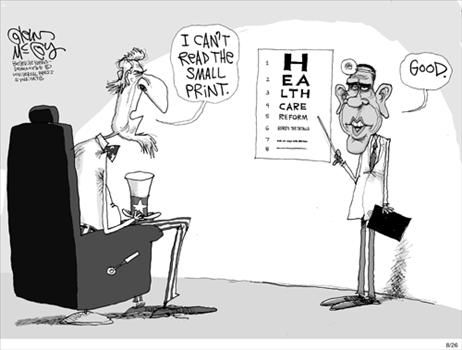
In the health debate, liberals sing Hari Krishnas to the "public option" -- a new federal insurance program like Medicare -- but if it's good enough for the middle class, then surely it's good enough for the political class too? As it happens, more than a few Democrats disagree.On Tuesday, the Senate health committee voted 12-11 in favor of a two-page amendment courtesy of Republican Tom Coburn that would require all Members and their staffs to enroll in any new government-run health plan. Yet all Democrats -- with the exceptions of acting chairman Chris Dodd, Barbara Mikulski and Ted Kennedy via proxy -- voted nay.In other words, Sherrod Brown and Sheldon Whitehouse won't themselves join a plan that "will offer benefits that are as good as those available through private insurance plans -- or better," as the Ohio and Rhode Island liberals put it in a recent op-ed. And even a self-described socialist like Vermont's Bernie Sanders, who supports a government-only system, wouldn't sign himself up.Of course, they also qualify now for generous Congressional coverage. Most Americans won't have the same choice. Some will be transferred to the new entitlement as it uses its taxpayer bankroll to dominate insurance markets. Others work for businesses that will find it easier to dump their policies and move employees to the federal rolls. Democrats also know that the public option will try to control health spending by squeezing payments made to doctors and hospitals, and by not paying for treatments that Washington decides are too expensive, which will result in inferior care.No doubt Mr. Dodd acceded to the Coburn amendment to blunt such objections, and in any case he'll strip it out later in some backroom. Judd Gregg was the only GOP Senator to oppose it, on humanitarian grounds. As he told us in an interview, the public option "will be so bad that I don't think anyone should be forced to join."
Much of the backlog of cases in our over-burdened courts has been created by the courts themselves, with adventurous judicial "interpretations" of laws that leave a large gray area of uncertainty around even the most plainly written legislation. Lawyers of course fish in these troubled waters, creating much needless litigation, but it is judges who have troubled the waters in the first place.Nowhere is this more true than in civil rights cases. Since the Constitution of the United States and the Civil Rights Act of 1964 both decree equal treatment for all, there should not be nearly as much basis for litigation in civil rights cases as there is - at least not in cases where the facts are well known and undisputed, as in the recent New Haven firefighters' case that made it all the way up to the Supreme Court.What was it that required three different levels of federal courts to try to figure out whether what actually happened was or was not racial discrimination - with a decision finally being reached by the narrowest possible margin of 5 to 4 in the Supreme Court?At the heart of much of this legal complexity and moral angst is a judge-made theory that a "disparate impact" of any job requirement on different groups is evidence of discrimination.With two very different theories of what constitutes job discrimination - either different treatment or different outcomes - it is no wonder that courts have tied themselves into knots trying to figure out whether a particular case shows racial discrimination, even when the facts are known and plain.The same notion - and the same confusion - applies in many other situations. If a higher proportion of blacks than whites get turned down for mortgage loans, then that too has been taken as evidence of racial discrimination.It doesn't matter if blacks and whites are different on innumerable factors that go into mortgage loan decisions, as are Hispanics or Asian Americans as well.All these groups have different credit scores, different incomes and many other differences. Why is it surprising that they have different loan approval rates? While the issue is often posed in terms of whites versus non-whites, whites also get turned down for mortgage loans more often than Asian Americans, who usually have higher credit scores than whites.Only the underlying dogma that different outcomes for different groups are evidence of discrimination makes this an issue - and a source of unending controversy and polarization.It is not that judges are incapable of seeing through the intellectual flaw in the "disparate impact" dogma. But that dogma is too central to efforts at social engineering to be given up for the sake of mere logic or facts.That is why courts split along ideological fault lines in cases like the New Haven firefighters' case, where the crucial facts are not even in dispute. The only real dispute is over whether a test is automatically biased if different groups pass it at different rates. Apparently the groups themselves cannot possibly be different, according to "disparate impact" theory.Facts play a very small role in such issues - including the facts as to whether social engineering - especially a lowering of standards for blacks - actually helps blacks on net balance. But empirical studies indicate that black students do better at colleges and universities where their qualifications are similar to those of the other students at those institutions and worse where they are admitted with wide disparities in qualifications.Where in fact have blacks been most successful? Sports and entertainment come to mind immediately. These are areas where blacks have to meet the same standards as anybody else.If Derek Jeter swings at three pitches and misses, he is out, just like any white ballplayer. If people stop watching Oprah Winfrey's program, it will get cancelled, just like anybody else's.The biggest beneficiaries from the "disparate impact" dogma are those who claim to be helping minorities. They benefit by feeling noble, winning votes or attracting money. The actual consequences for blacks - or for the polarization of American society - seems to be of little concern.